A Practical Model of the Idealized Reasoning Agent AIXI
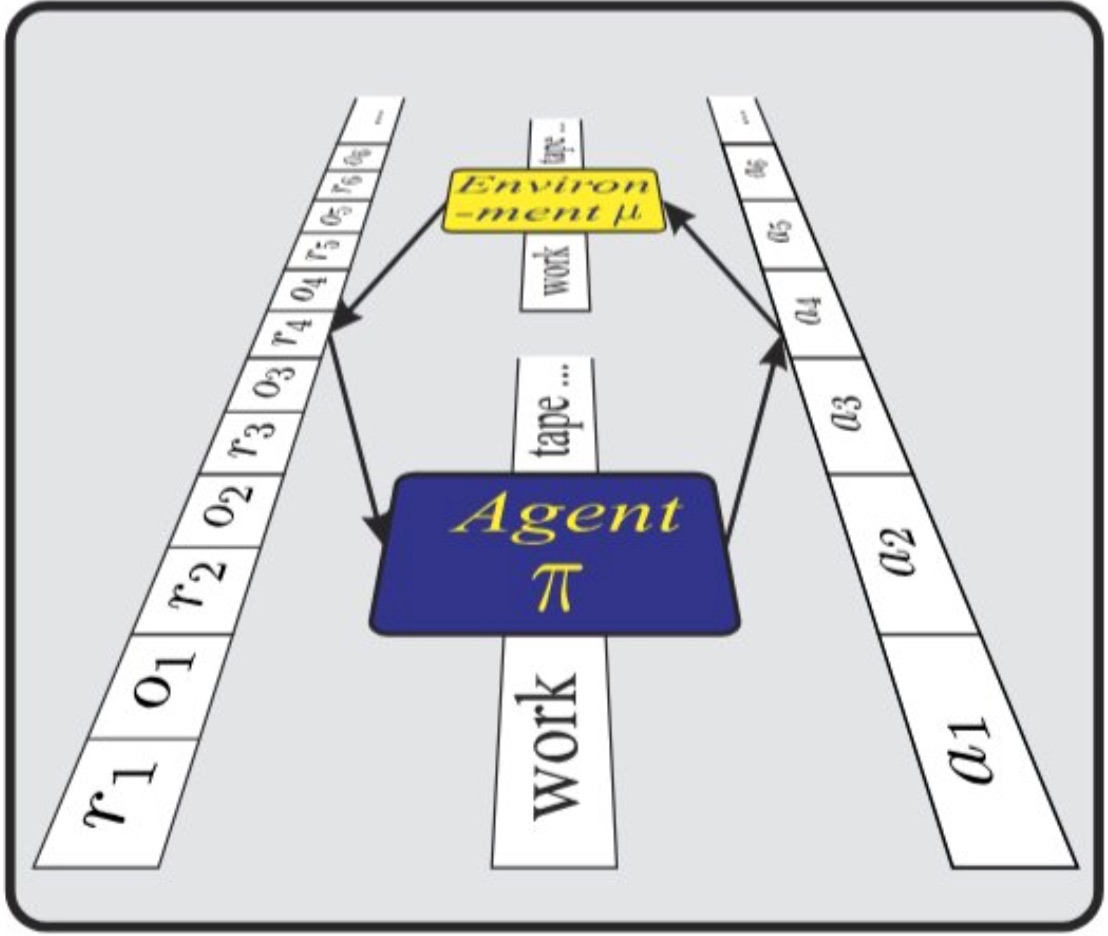
AIXI (Hutter 2005) is a formalization of a universal, ideal, and uncomputable agent. It maximizes a reward metric in an unknown environment. I asked: How many practical deviations from this ideal must be taken to achieve a functional agent?
This was a lesson in agent design. By replacing AIXI's policy (which involves uncomputable Solomonoff induction) with LLM-based decision-making, you get a distilled framework for rational action that's limited only by the LLM.
Keeping tabs on every deviation, I adapted AIXI to work through tasks using LLMs and a continuously updated model of its environment:
A constitution serves as the agent's moral and productive guide. A judge evaluates each of the agent's actions against the constitution, and returns a detailed report. This is the reward percept.
Tools are recast as "sub-environments:" self-manifested models of the true environment which are sampled to receive an observation.
A key philosophy of this project is that the data flow is entirely text-based. No attempts are made to compress data into quantitative metrics: essays are low-density but high-fidelity, and attention mechanisms do a decent job of picking out the meaningful stuff. To that extent, performance optimization then becomes mainly a compression challenge.